St.
Clair County
Remnants Of The Past

Collins – “The City on a Hill”
By Lola Boswell

Collins had its beginning in the late 19th century – about 1872. It took its name from William S. Collins who tended the post office and a store – both housed in the same building. The town then – what there was of it – was a “city on a hill” overlooking Little Weaubleau Creek. The storekeeper and postmaster became Judge William S. Collins, Judge of the St. Clair County Court and great grandfather to Shirley Collins who until recently was sheriff for many years.
There are two reports about the arrival of the railroad – one that it was built in 1885 and another that it “came through” between 1891 and 1896. Both dates could be correct. It was the Kansas City, Clinton and Springfield Railroad known as the Leaky Roof. It is not known how it got such a degrading appellation. At any rate business developed and Collins became a thriving little trade center. The town developed closer to Coon Creek to be near the railroad station which was called the depot. The Tillery Porte (pronounced Por-tay) building was built in 1898 beside what is now Buzz’s store. Porte (Ed, I think) and Henry Rieke (pronounced Reekie) were early day merchants but I don’t know if they worked together or separately. I don’t know what connection Tillery had with Porte, if any, or what Tillery he was.
At one time there were 38 businesses including two pool halls, two hotels, a flour mill, four merchandise stores, two banks, two blacksmith shops, one livery stable, a hardware store or maybe two and a garage. Dean Taylor operated one pool hall and it is believed that George Francis operated the other one. The flour mill stood on the bank of Coon Creek on the “other side” of the railroad track. It was a sightseeing spectacular for youngsters who accompanied their fathers “to the mill” to grind their grains into flour or meal or food for the livestock. It was operated first by a Mr. Bennett and later by a Mr. Williams whose daughter taught at old Tillery school which was originally called Oak Ridge. The mill burned and was never rebuilt.
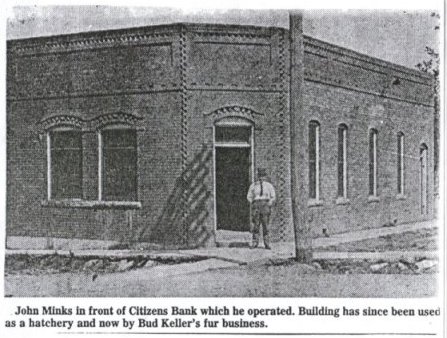
The two blacksmiths were busy from morning till night hammering red hot iron into shoes to fit their customer’s hooves. I am old enough to remember watching them work and I can still hear the clank, clank of their hammers while the horses waited patiently for their new footwear. Tom Follin’s shop was on the south side of Main Street. Bill Mason operated north of the bank in the area about where Bud Keller’s fur business is now. I know of this because it was my privilege as a small child to go almost everywhere my father went including funerals.
One of the two produce houses was operated by Joe Taylor. They were merchandise marts for farmers who sold their eggs, cream and poultry to get money to purchase supplies from among the four stores. We children had a little spending money but we had to earn it. My brothers trapped. My father helped me to set a trap which I suppose he watched for me but I caught a “possum”. I would sell it to Joe Taylor. When he asked what I wanted for it I replied, “A dollar”. The poor man must have wanted to faint but I got my dollar when 15 or 20 cents probably would have been average and 25 cents premium. He gave me four quarters and I got home with them. I was about five years old. I remember it well.
Joe Taylor “took over” the produce house from Emery Buzzard who had operated it in connection with the telephone office. This was about 1915 or before. Mr. Buzzard’s daughters (three as I recall) “manned” the switchboard, i.e., they ran the telephone office and directed calls to their proper destinations if the line was not down or some other difficulty didn’t interfere. This process was called going through central. Everybody furnished and strung his own line, often on trees, dead or alive, whatever was convenient and in the right place. The lines on conventional poles along the road were not much better. It is now known who financed the placement of those poles.
The service was not very good but it was better than none. In the early days, by prearrangement, the fiddlers and other musicians would tune up and people would listen to the concert over the phone. It was a strain on the telephone batteries but it was entertainment. Between acts, members of the “audience” would engage in witty conversation which provided lasting mirth.
Often neighbors listened in on conversations but it was not considered eavesdropping because everybody knew it. The phone was quite a toy.
Henry Glenn and “Thee” or “Theo” Waggoner were draymen who met the grain regularly to collect and deliver whatever came in for delivery. I can remember very little about them but Henry drove a beautiful span of mules and Thee Waggoner had a handlebar moustache.
The old brownstone hotel on Main Street (everything was on Main Street) just east of the depot was operated by Ben and Lily Bratcher. To my young mind it was the epitome of luxury living. The ground beside it was a beautiful carpet of grass and a lawn swing was so enticing that somebody was always sitting in it or so it seemed. Some of them may not have been invited. I wanted in the most pressing way to sit in that swing. Salesmen who came to town were “drummers” and they stayed at the hotel. There was always a joke or interesting story floating around about the drummers. It was a world of adventure and excitement to me which I could only dream about but never participate in. In its last days the hotel was operated by Mrs. Edith Taylor, widow of Joe the produce man. It was a sad day when that impressive old building had to be demolished to make room for Highway 13.
Doctors Selvidge, Sitton and Follin treated wounds and administered to the sick. Dr. Selvidge’s daughter, Elva, and Dr. Follin’s granddaughter, Mildred, live in Collins today. Dr. Sitton’s granddaughter, Kathleen Edwards, lives in Atlanta.
There were two barbers, Charles Sitton whose sobriquet was “Skinny” for reasons I don’t know and Jake (Jakie) Peterman. He lived in the country and walked to town to tend his shop.
Three churches kept the citizenry spiritually refreshed or appropriately sedated. Coon Creek Baptist which is older than the town itself had moved in from its earlier location “down the creek”. The floor was bare and it had straight-back benches for seats. One could tell by sitting on them that they were made of hard pine. A large stove stood in the center and the church was lighted by electricity from Delco power. “Uncle” Hardin Mason who lived next door was appointed to operate these facilities and at the proper time he would summon the people to worship by tolling the bell which could be heard for miles. Services were held on certain Saturdays. The farm women would attend church while their husbands did the marketing. One or two elderly townsmen attended also, apparently to get their afternoon naps. They were aided by the preacher. Usually the attendance was slight, hardly worth the preacher’s time. One afternoon two women sitting side by side noticed that some of the men were fast asleep. Only one of them was trying worshipfully to concentrate on the sermon when one of the men fell off the bench. It ended the service.
With the “turn of the century” came the Model T. It was immediately dubbed the tin lizzie, flivver, puddle jumper and other things but it could travel at the fantastic speed of 15 to 18 miles per hour. It was a modern industrial revolution. A farmer sent his young son to town one day and when he returned he was asked if he saw a car. The lad replied in excitement that he had passed one.
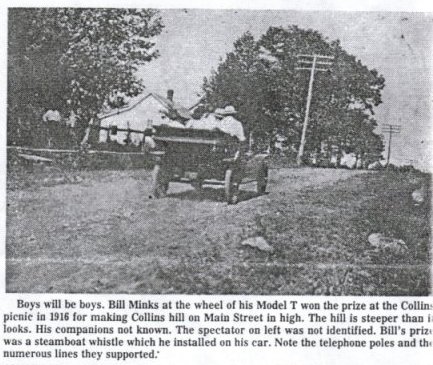
But just as horses needed metal shoes the Model T had to have mechanics and gasoline to keep going. Tires had to be changed, patched and inflated. Alfred Minks opened a garage and installed gasoline pumps. He soon needed help and his brother William (“Bill”) joined him about 1915. Collins was growing.
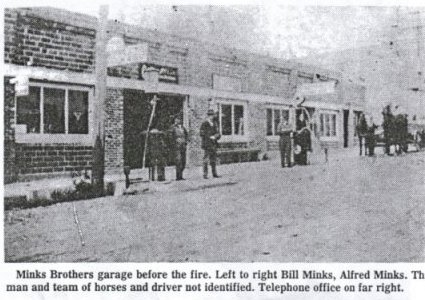
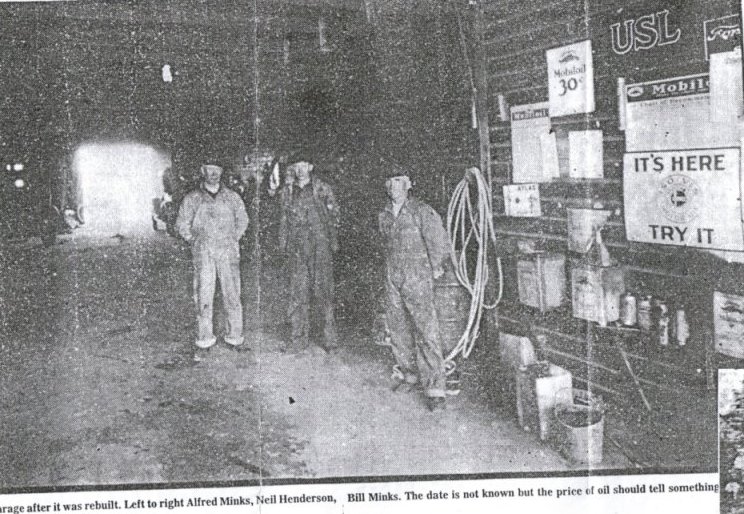
The Minks Brothers Garage became the hub on which the wheel turned. It stayed in business till 1967. When Alfred became ill Bill operated it alone “till Alfred gets well”. Bill was answering distress calls from stranded motorists in1959 when he was 86 years old. The garage closed in 1967 only a short while before Bill died at the age of 94. Alfred’s widow, Zoe, is still living. Though Bill and Alfred both worked on cars, their chief mechanic was Neil Henderson. It seems that people can’t live without nicknames. Niel Henderson became “Hawk”.
Life was struggle and hard work but people had their fun along with their tears and tragedies. Every year there was a two-day picnic in July. It was an event which couldn’t be missed. The youngsters went to rid the merry-go-round and eat ice cream from cones. Young adults found romance and the elders went to meet old friends. Oral Meredith reports that her father was among those instrumental in getting the merry-go-round to come. It was the main attraction. Probably nobody ever forgot the song, “in the Good Old Summertime”, played with unforgettable cadence while the ponies galloped on their appointed rounds. There was something for everybody including contests of various descriptions. The official name was “old folks” or “old settlers” reunion. It was held on the grassy bank of Coon Creek across the railroad track. A swinging foot-bridge over the creek was the only access and it was truly a swinging bridge. Though it was sturdy enough one had to walk in unison with the rolls and swells brought about by the footsteps of pedestrians.
The town took in or loosely embraced the “country” people whose trade boosted business. Mail was delivered to them on two routes which remain today. There were three John Higginses not related to each other. The method of distinguishing one from the other proves that people then were as innovative as any who proceeded or followed them. One of these men had a misfortune which left him with three fingers on one hand. You guessed it. He became three-fingered John. Another was bald. That identified him. The other one had a name also but as a precaution he must remain just plain John.
This was an era which came to a sad end in March 1920. A devastating fire, fanned by high winds, left the town in smoldering desolation. Only a few buildings survived. The Bratcher hotel, the Tillery Porte building, the store operated by Henry and Fanny Capps, the bank on the corner, the Wilson store and the building across the street to the east. The store operated by A.L. Davis (on the lot now occupied by Mrs. Kincaid) was not destroyed but it was so badly damaged, Davis had a fire sale and went out of business. The Minks Brothers garage was gone. Through tears and desperation the town was rebuilt with stunned resolve. The loss, however, was too great. It was never fully recovered. Times were changing.
Almost gone were the days when farmers brought their eggs, cream and poultry to town to exchange for money to buy supplies from local stores. Roads were improved to accommodate the ever changing, rapidly improving automobile. World War I had set the stage for the great depression of the thirties which in turn was followed by World War II. Rural telephone service was discontinued. Collins was lost but life remained.
Although the town had shifted toward Coon Creek and the railroad, the old post office and store building remained as a lonely sentinel on top of the hill. It was purchased by Don Peden who built a new house around it. Thus the first building in town, which was the town in the beginning, is still intact and standing though it can’t be identified as such. The Peden family was among the early settlers in the area which became Collins. All were noted for something. Doc Peden became famous for his team of oxen and for his ability to make molasses. His son, Albert, carried on this tradition almost as long as he lived.
At long last, after 65 years of extinction, Collins is going modern. Meantime, it has become almost noted for its three modern restaurants and good food with a busy truck stop and restaurant at the edge of town. There are four filling stations, one of which does garage work and provides towing service. A modern sanitary system is being constructed and is scheduled for completion by spring. Collins will then be on a par with larger towns. Attractively situated at the intersection of U.S. 54 and MO 13 it could regain its former status as a thriving trade center. Collins has potential.
Lola Boswell
Submitted by Stacy Kelly