St.
Clair County
Remnants Of The Past

MOB LAWS IN MISSOURI

10 June 1880, Osceola Sun
Osceola Sun, Thursday, 20 May, 1880 – Lynch Law.
One of the most horrible spectacles ever beheld in this county was
that witnessed last Thursday morning, when the cold, inanimate bodies of
John Parks, Chesley Pierce and William R. Smith were seen hanging from
trees a short distance south of town. In our local columns will be found
a detailed account of the action of the mob that lynched these men, but
as a journalist it becomes our duty to say something further about this
tragic affair, and we shall endeavor to deal fairly, calmly and
earnestly with the subject.
Some may attempt to justify the lawless act of the mob on the ground
that the criminals had obtained a continuance of their trials, and that
their attorneys hoped through the technicalities of the law, to finally
secure their acquittal. There is no crime that justifies the commission
of another, hence the excuse offered is weak and puerile in the extreme.
Under the law prisoners have a few rights – one of which assures the
accused a fair and impartial trial. To say that wrong-doers may be
acquitted through technicalities or loop holes in the laws is an insult
to the intelligence of the juries of the country. The juries ultimately
are the sole judges of the guilt or innocence of prisoners tried before
them, and they need not be influenced by attorneys unless they so
desire.
This country has laws for its government and St. Clair County has a full
corps of officers, sworn and paid to enforce their observance or punish
their violation within its limits. Any failure to arrest and vigorously
prosecute the perpetrators of crime can be traced directly to the people
who are responsible in a great measure for it. The people select the
officers of the law, judicial and otherwise, whose sworn and bonded duty
it is to see that all men charged with criminal acts are promptly and
rigidly prosecuted; also it is the duty of every good citizen to aid
officials in the arrest, and bringing to speedy justice of all persons
charged with law breaking and to see that all officers are vigilant in
performing their duties.
The three men hanged last week were forcibly and illegally taken from
the custody of sworn officers of the law, deprived of their lives by a
desperate mob, and rushed into eternity without judge or jury. At that
time they were securely guarded, and there is every reason to believe
that they would have been legally punished without delay. Pierce and
Parks were indicted at the last March term of circuit court for the
murder of William Bohon January 29th, and their trial would have
occurred at the May term of court – in session this week. Surely about
two months time was not too long for them to prepare for a trial
involving their lives. Smith had not yet been indicted, but was in jail
awaiting the investigation and action of the grand jury. It will thus be
seen that the law had taken charge of all of these men and would have
proceeded to deal out stern justice to them had they not been forcibly
removed from its custody by a set of unthinking, reckless men, who have,
by their illegal action, done this county and her people an injury from
which she will not recover for years.
We have always been, and ever expect to be, in favor of a most rigid
enforcement of the laws, recognizing as we do that without strict laws
and their enforcement neither life, liberty nor property would be safe
for an instant. We have no hesitation in saying that too many crimes of
magnitude have been committed in St. Clair County. The facts show a
truly deplorable condition of affairs, which every respectable citizen
must deeply regret, but how can crime be prevented by the courmission of
crime? There is strong probability that Pierce, Parks and Smith were
guilty of murder as charged; nevertheless, they were entitled to trial
by jury. Had they been proven guilty, the jury could have assessed the
death penalty and the proper officers would have inflicted it. By this
course the law would have been fully vindicated, the death of Bohon and
Tripplet avenged, and the county saved from the shame, disgrace and
humiliation which has fallen upon her by reason of the murder of three
helpless prisoners by a mob. Such high-handed, lawless acts ought to be
severely denounced by every good, law-abiding citizen. It is a
lamentable fact that there is in this county a desperate lawless
element, which has been noticeable for several years past, and given our
county a very unenviable reputation abroad. This element has been
encouraged and incited to its evil deeds by incendiary speeches and
fire-eating resolutions – it has grown bold and presumes too much on the
apathy and indifference of the officers of the law.
We believe that the severest punishment should be meted out to all
criminals, yet it should be done according to law. In a county the
prosecution of crime and execution of laws is chiefly entrusted to the
sheriff and prosecuting attorney. The sheriff is the peace officer of
the county, and it is his duty to arrest all violators of the law, and
by every means within his power to see that the statutes are duly
observed. The prosecuting attorney has exclusive charge of all criminal
proceedings; he advises the grand jury, draws indictments and conducts
the prosecution of those indicted. If either of these officers is
incompetent or inefficient the course of the law is retarded and
offenders go unwhipped by justice. What this county needs above all
things is a faithful and rigid enforcement of the laws. The people
should wake up out of the slumber they have been in for the past few
years and realize that they are responsible for any negligence in this
respect. This is an age of civilization – one in which law is supreme,
and not mobocracy. As long as a mob spirit is rampant in St. Clair
County, so long will the emigrant avoid us. It will take years for the
county to recover from the injury brought on it by the ill-advised,
murderous transaction of Wednesday night of last week. We trust that
every decent citizen in the county will condemn the affair in such
language and take such measures as will prevent its repetition – that we
may never again be compelled to chronicle a similar event.
Osceola Sun
Thursday, 20 May, 1880
The hanging of the three criminals, Parks, Pierce and Smith, who were
lodged in our county jail, seems to be the general topic of the day.
Many of our best citizens doubt the propriety of such action, believing
it to be rather a discredit to the citizens of our county and a
burlesque on officers, judge and jurors.
Osceola Sun
Thursday, 20 May, 1880
The Voice last week had incorporated in an article headed “Murder in
St. Clair County”, the following:
“When murderers go unwhipped of the vengeance of outraged justice, we
say emphatically that it furnishes more than the shadow of justification
for the people taking the law into their own hands and meting out its
righteous and deserved penalties upon transgressors.”
In the issue of the Voice for this week, in the course of an article
entitled “Enforce the Law”, appears the following:
“Mob law should be discountenanced by every good citizen as
unwarrantable at all times, as a dark, shameful reflection upon the
intelligence of the people of our county, and an outrage upon justice.”
Osceola Sun, Thursday, 20 May, 1880 – Just before going to press we
learn Mr. J.S. Smith, editor of the Voice, received yesterday morning a
letter through the post office at this place, purporting to have been
written by some member of the recent mob, in which they explain why
Smith was shot and how Gilbert made his escape. The writer requested
that Bro. Smith publish the letter.
Osceola Sun
Thursday, 20 May, 1880
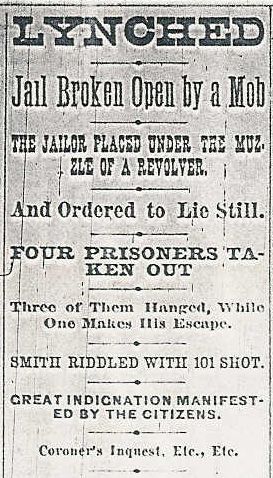
Lynched.
Jail Broken Open by a Mob.
The Jailor Placed Under the Muzzle of a Revolver,
And Ordered to Lie Still.
Four Prisoners Taken Out
Three of Them Hanged, While One Makes His Escape.
Smith Riddled with 101 Shot.
Great Indignation Manifested By the Citizens.
Coroner’s Inquest, Etc., Etc.
[From the Sun’s Extra of Thursday afternoon, May 13, 1880.]
Last night was one of those quiet periods when it would seem as though
all nature was at repose. The pale beams of the moon lighted up the
earth until perhaps ten o’clock, when the twinkling of the stars and an
occasional distant flash of lightning alone relieved the darkness of
night. The preceding day had been the warmest of the season and people
early retired, little dreaming that a dark and terrible tragedy would be
enacted in the town of Osceola before the morning light again dawned –
that a company of men were arming themselves preparatory to an assault
on the jail, which at that time contained four prisoners: Chesley Price,
who fatally stabbed William Bohon three miles from Osceola on the night
of January 29th last; John M. Parks, charged with being accessory to the
murder of Bohon; William R. Smith, charged with murdering David
Tripplett near Johnson City April 10th last, and William Gilbert, under
indictment for grand larceny.
About half past twelve o’clock a mob of men, armed and masked, variously
estimated at from 50 to 300, were gathered about the county jail. The
first intimation of their presence had by the jailor, Tom Emerson, was
some one outside calling for him to get up, they wanted to see him.
After parleying about 15 minutes and demanding that the keys be given
up, it was suggested that the doors be broken open. The suggestion was
immediately acted upon and the men proceeded up stairs, one of them
covering Emerson with a revolver. Once up stairs the lock of outer door
of the jail was quickly smashed and the crowd turned their attention to
the lock on the doors of the cell, in one of which was confined Parks
and Pierce, and in the other Smith and Gilbert. Sledge hammers soon
removed all fastening and mob and prisoners were together. The mob at
once took out Pierce and Parks, who offered no resistance, Parks
evidently understanding the situation and simply remarking that he had
done nothing to be hung for. Smith desperately contended for his life,
but was overpowered. Ropes were placed around the necks of the prisoners
and the mob then marched their victims down the stairway, and on
regaining the open air, the company formed in rank with the prisoners
under close guard. They marched out on to Chestnut Street and were
evidently intending to get on the Humansville road. When the mob had
arrived where Chestnut intersects Fourth Street and where the Warsaw and
Humansville roads diverge, Smith broke away from his captors and ran. He
was twice ordered to halt, but, preferring death by a bullet to being
lynched he paid no heed to the command. The leader of the mob then
called to his men to shoot, and he fell, riddled with a hundred shot.
The mob then passed down the Humansville road, dragging Smith’s body
with them, until the outskirts of town were reached, when they left the
highway and repaired to a grove of locust trees on what is known a the
Wilson tract of land, in Happy Hollow. Here Pierce and Parks were swung
up one tree and Smith was tied to another, leaving about one-third of
his body on the ground. The mob, having finished their terrible work,
disappeared in a southerly direction.
Gilbert is supposed to have escaped at the time Smith attempted to get
away. He went into the country, took a horse belonging to Mr. Corbin and
went east. Gilbert meet a gentleman on Weaubleau Prairie to whom he
related the action of the mob last night, and stated that he recognized
several members of the gang, but failed to give any names. He further
said that he had not stolen the horse, but would turn it loose when his
escape was assured. We understand the owner of the horse is in close
pursuit of him.
The bodies of the victims of the lynchers were left suspended until this
morning, when they were removed to the court house and a coroner’s
inquest held by Squire T.H. Wright. Following is the testimony:
”The Jailor’s Testimony: Thomas Emerson being duly sworn and as I am the
jailor; live in the jail at Osceola, St. Clair county, Mo. At about 12
o’clock last night some one called to me, and said, “I want to see you,
Tom.” I said nothing. They then said, “The keys are what we want.” I
parleyed with them about 15 minutes; then one man spoke and said, “Boys,
bust her in,” and they struck the hall door leading up stairs with a
sledge or something and the door swung open, and about 15 or 20 men
started up the stairs; the last man stopped on stairs about half way up
and opposite the door to the room I was in and threw his pistol down on
me, and said, “Don’t you stir!” About this time a man put a pistol at
the window near my head and said, “Don’t you get up!” The man that
seemed to act as leader said as they went up stairs, “Boys, don’t
shoot!” They broke lock on outer jail door, then the lock on cell No. 1
where Parks and Pierce were; then lock on cell NO. 2 fell from stroke of
sledge hammer and Gilbert was taken out, but it seemed from the noise
that Smith resisted. Think they brought all four prisoners down with
rope on necks; as they came down stairs Parks said, “Boys, I haven’t
done anything to be hung for.” When they went out and started to leave I
got up and went to outside door in other room and saw a man run and
heard shooting over on street near culvert. Seemed to be about 150 men
Outside. Think they had a rope on Gilbert, as they came down; don’t
think he could have come down after the rest left or my wife would have
seen him.
H. Weber on his oath says: Live near jail; heard noise; went out in
yard, could not see how many there were in the crowd; heard 8 or 10
shots when they got down near the culvert. Didn’t know any one; the
crowd made us stand back and not come near them.
Ben Decherd on oath says: Live south jail; heard pounding at jail late
last night; heard men coming away; as they were near culvert saw some
one start to run and a man called out “Halt!” twice and said “Shoot
him!” A pistol shot was fired from head of column, then one from center,
and then a gunshot from the rear from the flash of the shotgun saw a man
fall about 50 steps from road. Some of the men went out there, and said
they had him. They then went down the road.
Thomas Emerson recalled: I found a knife where Smith was tracked from
and about where the shooting was done; none of the prisoners had a
knife; don’t know where it is or was; also found a belt with a pistol
scabbard on near jail.
Frank Vaughan on his oath says: Was out late last night; started home;
heard men coming up the road; jumped over Uncle Peter’s fence and laid
down until they passed, then got up and went home around through other
part of town. Some were afoot and some were riding. I saw them go to
jail and saw no more of them.”
The verdict of the Jury was in accordance with the above testimony.
After the inquest the bodies of Smith and Parks were delivered to their
families, but Pierce was taken in charge by the county and buried in the
Osceola cemetery, he having no relatives in this vicinity. The
lamentations of the wives of Parks and Smith when they first beheld the
horrible sight presented by their departed husbands was heartrending in
the extreme, and the scene this morning on the court house steps would
have melted a heart of stone.
Pierce and Parks were arraigned at the last term of circuit court, but
their cases were not reached at that time, and the special term which
convenes next week was called for the express purpose of trying these
two men, and also Gilbert. A special grand jury would have been summoned
for the purpose of investigating the charges against Smith.
The lynchers quietly conducted their frightful work, and everything
seems to have been arranged with that system and secrecy which usually
characterizes the success of mobs.
Corbin’s horse was abandoned by Gilbert after he had rode it about six
miles, and the owner recovered his property today, finding the animal in
the grove near E.V. Hatch’s.
The following letters were picked up near the scene of the lynching,
Thursday afternoon, but too late for insertion in our Extra. We publish
them just as they were written:
Letter No. 1
St. Clair Co., Mo.
To the People, or Whom it May Concern:
We deem it just that we give our reasons for what we have done justice
in St. Clair county has been blindfolded by affidavits she has been
choked by legal tecknicalitles has been thwarted by corrupt judges and
attornies but last night she asserted her authority with a venjeance
once a month some of our citizens are murdered and there is no chance
for the punishment of the murderers by the powers that be – the law is
not enforced the juries of our county do their duty but the courts of
the State set aside their verdicts and murderers go free We have watted
hoped and prayed for the law to be enforced but in vain bohon and
triplet lies in their bloody graves and their widowed mothers mourn
without hope old man Flanders is in a dieing condition and Kidd is at
liberty old man ham lies in his grave and his murderers still lives in
hope of escaping the gallows therefore we see another chance of safety
for ourselves only in breaking the necks of murders and thieves We have
debated the matter long and seriously, we have acted and you have the
result we would harm no peaceable citizen we gratify no personal malic
Many things are charged against us that we have nothing to do with.
We are sorry For the victims all more sorry for the murdered men and
their relatives and we have stood this state of things Just as long as
we are going to there must be a change if any man is going to Steal and
Murder We will break his neck for we tolerate such things no longer and
we hope that we may never half to take the law in our own hands again We
allso understand that there is one ryors in Osceola that says that he
intends to line his pockets by the railroad bonded indebtedness of this
county if such is the Fact there is a healthier country than this for
him and the sooner he gets to it the better for him We hereby warn all
parties that are aiming to plunder the people of this county to beware
We have been plundered long enough We will protect any honest man but
thieves murders and plunders will be dealt with severely.
We will close with the request that this be published.
St. Clair Co. Vigilants.
Letter No. 2.
To All Whom it May Concern:
We the citizens of this Commonwealth have most solemnly resolved that
murder and Horse Stealing shall be stoped in this county and those that
have already comitted the deed shall suffer the penalty that they so
richly deserve. hereafter the law shall not be evaded. let no gilty man
escape justice.
we are tiard of the tactics in law
we are tiard of the tardiness of the law
we are tiard of the expenses
we are tiard of seeing money buy the criminal from justice. but the rich
and poor fare alike under the law where is Kidd who shot an old man for
wanting to pay an honest debt where is France the willful and deliberate
purdere, where is McFerson who killed Howard, where is hopper Earnest
and robinson who murdered Ham for his money Shall these heinous crimes
Continue and the law evaded, we say not.
Our Motto is let speedy and ample justice be meted out to One and all
the rich the poor the white the black the male and the female.
next comes the railroad Swindle of this county we must now beat it
vigorously and promptly all combined we say we will never pay it. let
the friends of the bondholder beware, the specticle man must show some
visible means of support all others in this county who are working in
the interest of the bondholder must desist at once or they will be dealt
with likewise, do not think we are trying to scare, for most verily we
mean business, why have an emigrant aid society in this county with the
prison full of thieves and murderers and as many turned loose, and at
large, first (clere the coast) and then emigrants who are worthy will
make their advent into our county, we put our veto on all Swindlers
murders and lawlessness of whatever kind or description it may be The
honest and upright citizen need not fear, but on the contrary they may
rejoice for most assuredly they are the ones who will have our support
and protection Some people may be curious to know who wrote this epistle
but they will never know others may be wanting to know who it was that
did the deed but we warn them for their own good not to put their snoot
in that direction for it is sure to get burnt Mr Silsby will hand over
to those that gave them the notes that were executed to lawyer Some for
the prosecution of Parks and Pierce for he will not be called on to
prosecute them the work that Stone has already done he will be paid for,
the Osceola Papers may publish this If they choose, no new case is
desired but if they come up they will be attended to promptly this is
the best emigration aid society that we know of.
Epluribus Unum.
The original copies of the above letters are on file in our office, and
open to the inspection of any one desiring to see them.
Osceola Sun
Thursday, 27 May 1880
The Osceola Lynching.
We give elsewhere an account of the terrible affair which took place at
Osceola last week, in which three prisoners awaiting trial were taken
from the custody of the law by a mob and hanged. That such a proceeding
should take place in Southwest Missouri should impel the blush of shame
to mantle the cheek of every right minded citizen. In this case there
are special features which render useless the pleas which usually are
made to excuse such lawless acts. The victims were persons charged with
murder committed months before, and passion had had time to cool. The
offenses of which they were accused were committed during the affrays,
and there certainly was the possibility that cases of self defense might
be established. The law holds full away and its officers are capable of
vindicating it. It is difficult to urge in this case any justification
for a resort to mob violence, if indeed any excuse can be found for it
at any time.
Upon the unimpeded administration of our laws alone rests the security
of life and property. The law’s delays are sometime expensive, and
sometimes escape the punishment they richly deserve. There are
imperfection sin our laws, and in the modes of their administration,
which sometimes become burdensome. Courts are not exempt from human
fallibility and sometimes grievously err.
But laws, courts and officers are the arbiters which we have ourselves
appointed to protect society and adjudge between man and man. Their
responsibility is great, both to heaven and to us. If they fail to do
their duty we have the power to displace them. The people have not the
power to usurp their functions and take into their own hands the
administration of justice. No right-minded man will desire to do it.
In obedience to the law is our only safety. The law stands as our
defense against those who wish us ill. How foolish then to assist in
tearing down this defense. May we not expect that the very demon which
will thus unchain will turn and rend our own bodies?
These are some of the considerations which must forever condemn mob law.
We are happy to say that in Polk county we have a people who are not
accustomed to resort to mob law. Under no provocation have they been led
to forget their duty to the law. May the Herald never be compelled to
chronicle in Polk county such an event. – Bolivar Herald
Osceola Sun
Thursday, 27 May 1880
Letter from the
Moderators.
Following is the letter to which we referred last week as having been
received by J.S. Smith, editor of the Voice, last Wednesday, with the
request that he publish the same, which he did that afternoon in an
extra:
”We, the Moderators of St. Clair have hung Smith, Parks and Pierce, and
we wanted Gilbert, but Parks and Pierce said that Gilbert was gone off
on trial. He was hid back in the corner, and they denied his being there
until we got in about fifty steps of where we hung them when Parks said,
“Boys, I won’t lie about it,” and said that Gilbert was back in the jail
in the corner of the cell. It was too late to go back and catch him for
he was out and gone. He was not seen by any of the crowd that night, for
we wanted him as bad as we did the rest of them. The reason we shot
Smith was because he had a knife and tried to fight, when they shot him
and he restarted to run when they shot him with a gun. We expect it was
a lucky thing for Tom Emerson that he was shot, for Smith would have
tried him and may be killed him or got away. We have understood that
Smith’s wife brought him a pair of trousers which had the knife
concealed in them.
We have done the work and we done it for the benefit of the honest
people of St. Clair county, that try to make an honest living for their
families. Criminals can be tried by the law and a decision given, and
then run at large after costing the county three or four thousand
dollars at the people’s expense, and then the guilty go unpunished. We
don’t want to hurt or damage anybody, only the ones that we think is
guilty. Our unjust demands is more than we can stand without heaping an
over load on us. This county has been imposed upon by a certain class of
men and they are getting tired of it; the law is not any account and we
propose trying Mob Law.
Moderators.
Osceola Sun
Thursday, 27 May 1880
A great many of the papers throughout the State copied The Sun’s Extra, thus giving their readers the earliest and best account obtainable of the lynching of the three prisoners here on the 13th.
Osceola Sun
Thursday, 27 May 1880
County Correspondence,
Speedwell Township.
The good law abiding citizens of our township were very much shocked
when they heard of the lynching of those men in the Osceola jail, and it
is the unanimous saying that if those men cannot be brought to justice,
who are secure in their lives, liberty and property? And ask where will
be the end? We are for law and order and are ready to assist the court
to preserve it and protect every man in his legal rights.
Osceola Sun
Thursday, 27 May 1880
Good Citizens vs. Mob Law.
The promptness with which Gov. Phelps has expressed his determination to
have the perpetrators of the recent outrages in this county severely
punished is only equaled by the unanimity with which a large majority of
our people condemn the action of the mob. It is now, and always has
been, one of the consequences of free government that occasionally
unprincipled demagogues, under the pretense of accomplishing some
supposed public benefit, lead astray the people and become their
masters. There is not now, neither has there ever existed in the
politics of St. Clair or any other county a legitimate place for the
unprincipled demagogue; but, like weeds in the corn and chaff amongst
the wheat, he is always to be found as a necessary evil to prevent a
political millennium. The mob violence by which Parks, Pierce and Smith
lost their lives could be no surprise to those who have been familiar
with the means and methods by which certain parties obtained control of
the county. It may be that some who were active in the mud shower of
1878 thought that night riding would stop with that campaign, but they
were sadly mistaken and are now forcibly impressed with the evil results
of their hasty and illegal advice. They will be powerless to quiet them,
yet there is going to be a reign of peace and quiet here in the near
future. The good citizens, who constitute a large majority of all people
of every party and nationality, are determined that mob law shall be
suppressed in this county – that night-riding and threatening letters
shall become things of the past. The State authorities will find hearty
support and encouragement amongst our citizens in any measure they may
see fit to adopt which will result in bringing to justice the murderers
of those imprisoned on charge of murder. In war it is regarded by all
civilized nations as a mark of brutality and cowardice to murder an
unarmed prisoner; it is indicative of much more cowardice to do so in
time of peace. It proves conclusively that those who engage in it are
willful, deliberate and malicious murderers, without a shadow of
justification. It has always been possible, since the close of the war,
for the civil authorities to enforce the law in St. Clair County, and
any instance in which this was not done simply demonstrates either the
inefficiency of the officers or their sympathy with lawlessness.
Osceola Sun
Thursday, 27 May 1880
Gov. Phelps has written a strong letter to the Adjutant General, urging him to take the necessary steps for the capture, arrest and conviction of the men engaged in the recent Osceola lynching. In this matter the Governor is adhering to a policy which has marked his administration from the beginning – that of enforcing the criminal laws of the State without fear or favor. His term of office is nearly out, and he is inelligible under the Constitution. But whoever his successor may be, he can do no better than imitate his good example of nerve and vigor in dealing with the lawless classes. Four years more of the Phelps style of doing things would do more good for Missouri in the way of encouraging immigration than has yet been done by any society organized for that purpose. – Globe-Deomocrat
Osceola Sun
Thursday, 27 May 1880
Gov. Phelps Letter on Mob
Law.
Gov. Phelps has issued the subjoined instructions to the
Adjutant-General of the State. It will be seen that our vigilant and
energetic chief magistrate is determined to do his whole duty in the
prosecution and punishment of violators of law:
State of Missouri,
Executive Department,
City of Jefferson, May 17, ’80.
To Gen. E. Y. Mitchell, Adjutant-General:
Sir – A great outrage has recently been perpetrated in St. Clair county.
An adjourned term of the circuit court will be held in that county
tomorrow. The prosecuting attorney of St. Clair has an indictment
pending against him for official corruption. He may be innocent of the
charge preferred against him, and as such is the legal presumption he is
entitled to the benefit of that presumption. The outrage just
perpetrated in that county is one of the fruits of the lawless acts of
1877. The persons who perpetrated those crimes in 1877, or those who
justified that lawlessness, though not participating therein, are now
reaping the bitter fruits of the bad seed then sown. I am satisfied the
good men of that county are in the majority – largely in the majority –
but many of them have been inactive and supine in bringing offenders to
justice. This must not continue, or they will necessarily be classed
with the evil men. Generally, the officers of the law can enforce the
laws with ordinary assistance; but when a prosecuting attorney is
arraigned for official corruption, he becomes an object of distrust, and
whilst I have confidence in the ability and fidelity of the bar of St.
Clair, with the exception of this one indicated, I deem it advisable
that the State should be represented before the grand jury and in the
court room by one who is an entire stranger to the persons charged with
the commission of these great crimes. Men of that county have taken the
law into their own hands and have murdered persons confined in jail
awaiting trial. The attorneys of that county, I have no doubt, are
employed to defend some of those who were engaged in these wicked acts;
hence they cannot be asked to prosecute, even temporarily.
I hope it will not be necessary to invoke the authority contained in
Sec. 1804, page 301, Revised Statutes, and cause these crimes to be
investigated and prosecuted in another county. But if that exigency
shall occur, the authority referred to must be exercised. The murderers
of the three men confined in the jail shall be prosecuted. If the
indictments cannot be found in St. Clair, they can be found elsewhere,
and thus will the offenders be brought to trial.
You will immediately go to St. Clair county, exhibit this communication
to the Hon. John D. Parkinson, judge of the circuit, who I trust will
immediately appoint you to prosecute this term. So long as the
indictment is pending against the prosecuting attorney, he ought not to
be permitted to go before the grand jury, unless he shall be called
there as a witness. I trust the judge will clothe you with all the power
necessary to enable the object in view to be accomplished. And should
any of the resident attorneys, feeling the peace and good order and fair
name of St. Clair has been outraged, be in a situation to aid you, you
will accept their services, should you need assistance.
Respectfully yours,
John S. Phelps.
Osceola Sun
Thursday, 27 May 1880
Jefferson City Eclipse: Gov. Phelps has requested the judge of the circuit court of St. Clair county to appoint Adjutant General Mitchell to prosecute the rioters who recently took three prisoners from the jail at Osceola and hung them. Gen. Mitchell is one of the ablest criminal lawyers in the State. Gov. Phelps is evidently determined that to the full extent of his powers orderly communities shall not be rendered disorderly by mobocratic combinations.
Osceola Sun
Thursday, 27 May 1880
Following are the names of the grand jurors empanelled last Thursday: Chas. W. Nesbit (foreman), Ben Burch, John Chambers, Levi H. Croy, J. McH. Ledbetter, T.E. Wilkinson, Jas. Dade, Chas. Suggs, S.M. Evans, Phillip Van Allen, Peter Allenbaugh, Ben Prier.
Osceola Sun
Thursday, 10 June, 1880
Other Comments on Mob Law.
Bates County Record: “No good citizen but will unhesitatingly denounce
the outrage committed by this mob. The prisoners were in the hands of
the law, the courts of St. Clair county were in full operation, and to
thus drag them from jail and execute them without trial was
cold-blooded, pre-meditated murder, and the perpetrators should be
punished as they deserve. Where such outrages are committed there can b
no safety in society, and it is about time they were stopped in
Missouri.”
Henry County Democrat: “While mob law may be the expedient in very rare
instances, we can see no just or equitable ground in this case on which
the least plea for justification may be based. The accused were in jail,
and court convened last Monday for their trial. True, their crimes were
heinous, bout to what extent is law and justice meted out when enforced
by a wild rabble? We cannot close this article without inviting especial
attention to the following editorial from the Voice, published on
Wednesday morning preceding the mob that night. The Voice is a faithful
expounder of Greenbackism, and knows no middle ground. Jennings, the
indicted prosecuting attorney, was elected on the Greenback ticket, and
although prostituting his official calling is permitted by his party to
continue in office. With that paper advocating mob violence, a
prosecuting attorney indicted for corruption, it is no wonder that the
scenes of last week were enacted.”
Osceola Sun
Thursday, 10 June, 1880
Mobs in Missouri.
It is incumbent upon every one in authority in the State, and for the
matter of that upon every one not in authority also, to take some action
to put a stop to the cowardly and outrageous mob spirit that is rampant
in some of the counties, and is continually breaking out in unprovoked
acts of violence and lawlessness. Mobs and the acts of mobs are always
to be deprecated. In the nature of things a mob is the offspring of
cowardice, and the acts of mobs are performed without any knowledge of a
regard for the guilt or innocence of the persons who are their victims.
Laws are intended to protect people as well as punish them. Every person
is supposed to be innocent until proved to be guilty. But a mob,
actuated by passion or by cool malevolence and a desire to exercise its
brute power, ignores the question of right or wrong, tramples the law
under foot, violates every precept of humanity and justice, endangers
the safety of society and sets a precedent which, if followed, can only
result in universal anarchy and social disintregation.
When some great and unprovoked crime has stirred a community to its
profoundest depths, there may be some excuse for a counter outburst of
feeling that in the passion of the moment inflicts lawless justice by
summarily dispatching the criminal. But even then it is punishing one
crime by perpetrating another. The mob spirit that we have spoken of as
rampant in this State, however, has no such excuse. We recall at this
moment two manifestations of it. Not long ago two negroes were killed or
were suspected of killing another negro in Randolph county. The
suspected men were arrested and confined in the Moberly jail. In the
dead of night a mob came, overpowered the jailor, took the prisoners out
and hung them. There was nothing particularly atrocious about the crime
to arouse popular indignation in an unusual degree. The mob cared
nothing for the dead man. It was not shocked at the thought of the
crime. Its action was purely malevolent. It was composed of brute and
cowards who delighted in the opportunity to perform a brutal and
cowardly act. Ninety-nine citizens out of a hundred of Randolph County
knew nothing of the intention of the mob, and have no sympathy with it
since. Their offense is that they have not vindicated the law by forcing
the civil officers to run down and bring the brutes to trial and
punishment.
Because the law has not been enforced in Randolph County, another set of
ruffians have got together in St. Clair County, forced the keeper of the
jail at Osceola to surrender his prisoners to them, taken them out and
hung three of them. The men who were hanged were charged with murder.
They may or may not have been guilty. The mob neither knew nor cared
whether they were or not. But whether they were or not society cannot
trust the righting of its wrongs to such men as composed that or are
like to be composed any other mob. The St. Clair County mob was the
logical sequence of the Randolph mob. There are bad and brutal men in
every community, who are always ready to engage in such enterprises,
when they can do so with impunity. By a terrible perversion of the
better qualities of their natures they have come to take pleasure in
doing so. They must be stopped, and the only way to stop them is to
pursue them, arrest them, try them and execute them as murderers. It is
said the people of St. Clair are determined to make examples of the
members of the gang in their county. If they do there will be an end of
mob law in Missouri for years. If they don’t the precedent of St. Clair,
added to the precedent of Randolph, will surely result in other
disgraceful outbreaks of the same kind.
The executive branch of the State government may be relied upon to do
its entire duty in this as in every other case. But it is to the local
authorities that we must look for the suppression of crime. No power or
authority more distant than that of the very counties thus afflicted can
be potent in enforcing the laws. – St. Louis Times
Osceola Sun
Thursday, 10 June, 1880
Judge Parkinson and Adjutant-General Mitchell have won the admiration and deep gratitude of every law abiding citizen of St. Clair County, irrespective of party, for their untiring efforts in investigating the recent mobbing at this place.
Osceola Sun
Thursday, 10 June, 1880
Arrest of Barker, Grimes and
Carry. On Thursday of last week, upon information of the
Adjutant-General E.Y. Mitchell, who had been conducting the
investigation before the grand jury regarding the recent action of the
mob at this place, Judge Parkinson issued bench warrants for the arrest
of Decatur Grimes, Hiram Curry and Jack Barker. They were arrested and
brought before Judge Parkinson, sitting Thursday as an examining
magistrate. Adjutant-General Mitchell conducted the prosecution, while
J.C. Ferguson defended. Thursday, Friday and Saturday were occupied with
taking the testimony, the substance of which was merely circumstantial.
Several witnesses swore that they recognized Jack Barker’s voice while
breaking into the jail; some stated that, hearing Barker talk afterward
they thought his voice was the one they heard on the night of the
hanging, and others testified that he had on a white linen shirt next
day, and they had known him a number of years and it was the first time
they had ever known him to have on that kind of a shirt. Another said he
had an interview with Barker at the court house the next morning after
the hanging. Barker told him the mob who hung Pierce, Parks and Smith
said that if France was not arrested and given a fair, square trial to
avenge the death of the man he murdered he would be taken out and hung.
Still another testified that Barker said the water bucket at the spring
did good service the night of the mob – in dipping water.
The gist of the testimony against Grimes and Curry was that they were
seen near each other on the afternoon of Tuesday before the hanging;
that Curry was seen going through Woodall’s farm with a man’s saddle.
Then they met at Mr. J.J.C. Woolf’s next evening about sundown, borrowed
his saddle and rode off together. Curry returned between 10 and 12
o’clock next day, and Grimes returned to Woodall’s about 8 or 9 o’clock
next morning.
A short time was taken up in the argument of the case, after which the
court reviewed the testimony and examined the law, and committed Barker
to jail without bail. Grimes and Curry were bound over in the sum of
$6,000 each. Pursuant to the orders of Judge Parkinson, last Sunday
Sheriff Gordon conveyed the three prisoners to the Henry county jail.
All the papers pertaining to the recent investigation have been
certified to the Henry circuit court, and the prisoners will await the
action of the grand jury of that county, which convenes on the 2d Monday
in August.
We learn that Grimes and Curry were released on bail yesterday.
Osceola Sun
Thursday, 10 June, 1880
Murder in St. Clair
County.
Under this head, the Osceola Voice of the People has a forcible article
denunclatory of the spirit of lawlessness which is the foundation, and
often the provoking cause of the brutal butcheries that continue to
continue to disgrace the annals of Missouri, and help render the name of
the State a by-word in the mouths of its enemies, as well as a shame and
a reproach to those who feel an interest in its success.
The article denounced in fitting terms the weak administration of the
laws by which men, taken red handed from the commission of an almost
unprovoked assassination, were permitted on one pretext or another, to
escape the punishment which law, as well as justice, and the sentiment
of the community should award to their awful crime.
Had the Voice stopped there its course would not only have been
commended, but entirely commendable.
It would have assisted in forming a public sentiment in opposition to
that spirit which seeks the revolver, the bowie knife and the shot gun,
on the slightest provocation, and assisted in teaching the hard duty
which seems to be devolved upon every true friend of humanity to try and
bear with patience insults, and even outrages, which can only be
resented by shedding the blood of even a seemingly hopelessly vile and
brutal aggressor.
But the Voice was lifted in favor of a seeming necessity for mob law,
first by deploring any necessity for it, and then by more than
intimating that such necessity existed there.
We are not sufficiently clear in our recollection of the events in our
sister county to base an opinion upon the correctness of this view of
the case, having in view only one legally arbitrated murder case there,
of recent date, where, according to the testimony, a man invited a
former friend to his house and after the latter had fastened himself
there like a leach, and violated the rights of hospitality, by breaking
up the household, was assaulted, and reaching with the feeble hand of
conscious guilt, for a gun to defend himself had it wrested from his
hands, and the loads fired through his own body.
The slayer was in this case tried, and the circumstances operating in
his favor he was not hung, but it would seem as though a sentence of
forty years ought to have been deemed sufficient punishment in that
case.
There were other instances, but no trial had taken place. The parties
were in the hands of the law, and though it is notorious that Missouri
jails are shamefully insecure, one-half of the time and labor necessary
to get a mob worked up to the point of breaking the law, would make
secure the weakest jail in the State, or furnish a guard for the whole
time necessary for the criminals’ confinement.
These prisoners had the right to a fair trial; instead of which they
were dragged from the place of their confinement and murdered by a
refinement of brutality which will go far to prove the worst charges the
enemies of Missouri can make against her.
There is no evidence to show that such result was designed on the part
of the conductors of the Voice, but the fact that the terrible tragedy –
the horrid details of which are being spread far and wide, and are
published elsewhere, in our columns – was consummated within 18 hours
after the publication of the article, leads to the belief that too much
care cannot be used in such cases, since a single word of encouragement
may often stimulate the blind and unreasoning impulses of an infuriated
mob until acts are committed that are ten times more brutal and
dangerous to the public peace than the abuses they are seemingly
intended to correct.
Many a man, innocent of the charges against him has by the overwhelming
nature of circumstances, been made to appear hopelessly guilty, and sent
to eternity, when if time had been given he would, as many similarly
situated have done, have proved himself clear, and we can think of no
more terrible position to occupy, than one where the thought will come
to harrow the soul of any man who may have assisted, in word or deed, in
the shedding of innocent blood. – Warsaw Times