St.
Clair County
Remnants Of The Past

Research Team visits Osceola-Weaubleau Impact Site

St. Clair County Courier
6 May 2005
On April 15, Kevin Evans, Assistant Professor of geology at Southwest
Missouri State University, led a tour of SMSU and Central Missouri State
University students around the meteor site located near Vista, and
affecting a wide triangular area from Vista to Osceola and Weaubleau.
Evans was born in Versailles, Missouri. He received his B.S. in geology
from SMSU, and a Ph.D. in Geology from the University of Kansas. His
specialty is stratigraphy the study of layered sedimentary rocks.
Evans worked six years for the U.S. Geological Survey in Menlo Park,
Calif. He said he considers it his service to the United States because
he didn’t make much money. He was involved with a number of interesting
projects including the coral reefs for Hawaiis, petroleum resources of
the Alaska National Wildlife Refute in 1002 Area and the National
Petroleum Reserve, Alaska, and salt-water intrusion into fresh-water
aquifiers in the Los Angeles Basin. In 2001, he returned to Missouri and
began teaching at SMSU as in instructor.
The Weaubleau-Osceola structure is about 340 million years old.
Geologists refer to time period as the Mississippian Period. They know
this because it deformed, folded and fractured limestones of that age
but sandstones these are about 300 million years old; geologists refer
to that time as the Pennsylvanian Period. It is sort of like a bookmark
in the layered rocks that have recorded Earth’s history.
The Weaubleau-Osceola structure is unusual in that it is essentially
complete and very well exposed. Evans used this analogy: meteorite
impacts are like gunshots. They penetrate part of the Earth’s crust, but
it would be difficult to tell when this event occurred except for the
fact that it was covered fairly quickly afterward. If it remained
completely covered, it would be difficult to recognize it. Erosion has
exposed part of the structure to make it possible to study it in detail.
Twenty-seven impact structures are known in the United States. Two of
the accepted impact structures are in Missouri: Decaturville about 10
miles north of Lebanon bordering LaClede and Camden counties and Crooked
Creek about 10 miles south of Steelville in southwestern Crawford
County. Both of these are fairly deeply eroded. The Weaubleau-Osceola
structure is currently not on the list because researchers are still
gathering evidence of the impact. It is virtually assured that it will
be added to the list. Evans expects Weaubleau-Osceola to be added to the
list of impact sites someday, Evans doesn’t claim to be an impact
expert. He says, “I’m just kind of an interloper,” one who normally
works on plain old sediment.
Conducting research in Antarctica had been one of the thrills of Evans’
career, but of the Weaubleau-Osceola discovery he says,
“This is the most exciting project I’ve ever been on.” The town of
Vista, population “about 80”, is excited about nearly Weaubleau-Osceola
site too, and is thinking of making it a tourist attraction. Evans
enjoys talking to school children about the site. He said that he likes
opening their eyes to the reality of asteroid impacts by pointing to the
giant hole in their own backyard.
A half-mile wide asteroid strikes Earth on average every 500,000 years.
Objects the size of an aircraft carrier hit 10 times as often, and
football-field size rocks come every approximately 10,000 years. An
asteroid that size moving at 20 miles a second can punch out a crater
more than a mile wide, slamming into Earth with 80 megatons of energy,
more than the largest hydrogen bomb ever exploded.
A three-mile-wide object still much smaller than the one that most
likely killed the dinosaurs delivers more energy at the moment of impact
than all our planet’s earthquakes, volcanoes, and tsunamis typically
release over hundreds of years. Short of the sun going nova, an asteroid
impact is the worst natural disaster that can befall us. Don’t take
comfort in the frequency estimates, either: they are only statistical
averages. Any of these things could happen tomorrow.
This is a cooperative research effort that involves geologists from
SMSU, University of the Missouri, Missouri Department of Transportation,
the Missouri Geological Survey, University of Oklahoma, Ohio State
University, Appalachia State University, University of Vienna Austria,
and Humboldt University Germany. Some of the principal features that
support the idea that the Weaubleau-Osceola structure is a meteorite
impact site include: two eccentric round topographic features that
surround an area of intense geologic deformation. Crater and relict
round features are common in many, but not all, impact structures. Rocks
are intensely folded, fractured, and brecciated or broken to pieces in a
localized area that is surrounded by relatively undisturbed rock. The
breccia is rock that has completely mixed rock clasts and fossils from
strata that include the limestones and rocks below. Quartz grains in the
breccia rock have planar features that only form under extreme
pressures. The element nickel is found in minerals that are in the
breccia. Nickel is common in meteorites. Granite blocks have locally
been lifted up to within 200 feet of the surface. Normally, these rocks
are at 1,400 feet depth in this area. Uplifted areas are common in
meteorite impact structures.
The meteorite impact hit in the shallow oceans, that covered this area
during the Mississippian Period. Looking across the hills and hollows of
the Ozarks, it may be hard to imagine but this area was once covered by
oceans, but the fossils we see in many of the limestone rocks in this
area demonstrate that this was once under the seas.
Geology is fascinating to study. We have such a limited perspective as
humans. We live to be into our 80’s or 90’s if we are lucky. If we
preserve the memories of those who have gone before, it may be up to
four generations. With writings and sacred teachings, we can stretch
history back a few thousand years. Yet we know humans lived and painted
horses and cattle on cave walls some 40,000 years ago.
Homonids existed long before that but only a few tens of millions of
years. Most of the rocks exposed in Missouri preserve records from much
older times, when the continents were in different configurations.
Still, these ancient events like a 340 million year old impact hold
valuable information for us. We know that impacts have occurred in the
past. They will happen again. What are the risks of future impacts? What
sort of devastation occurs when they strike? Would a marine impact
generate a deadly tsunami? How can we best survive future impacts? These
are the sorts of questions where studies of an ancient impacts will
help.
The conference will be held May 21-23, 2005. They will have a day of
talks and poster presentations followed by two field trips. The first
field trip is to the Weaubleau-Osceola structure on May 22. The second
field trip will visit the Decaturville and Crooked Creek impact
structures. They expect about 50-60 people from around the world to
attend the conference.
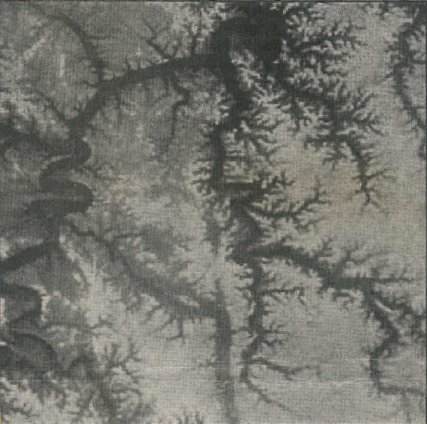
Picture caption:
The Weaubleau-Osceola structure spans 19 km (the large circular drainage
outlines the area of deformation above), but imagery and field data also
indicate the extent of the transient crater is only 7 km.