St.
Clair County
Remnants Of The Past

Evidence of Meteorite Found Near Osceola

The Springfield News-Leader
12 April 2003
Evidence of meteorite found near Osceola
Crater could be one of the largest in the United States.
By Mike Penprase
News-Leader
The moment of impact came as a flash of blinding light then a
bone-rattling boom and a blast.
It obliterated the future site of Osceola, Weaubleau and Bolivar and
flattened much of the landscape nearly to where Springfield is today. A
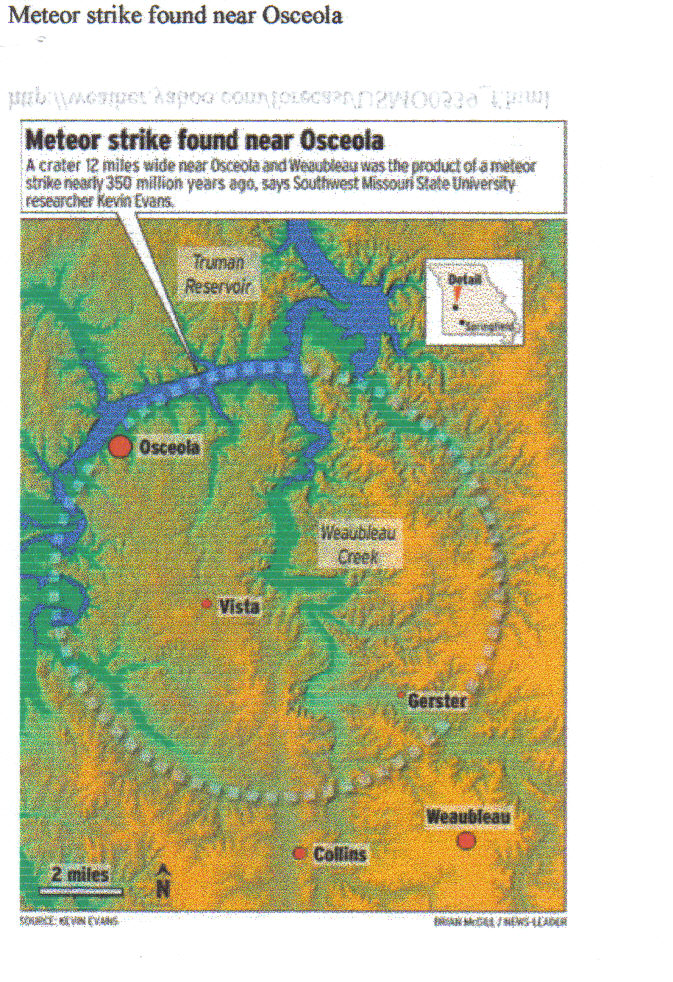
steaming, smoking crater 12 miles wide remained.
A Cold War scenario of a Soviet strike against Minuteman missile sites
around Osceola?
Try a historical fact.
Researchers at Southwest Missouri State University believe such a
cataclysm occurred some 350 million years ago when a meteor 400 meters
across – that’s more than twice the height of the Gateway Arch in St.
Louis – and moving several times faster than a rifle slug eventually
became a meteorite, entered the Earth’s atmosphere and hit the planet.
The researchers have banded together to dig more deeply into research
started by SMS geologist Kevin Evans, who considers himself lucky for
discovering what could be a world-class meteorite crater.
“Other folks have come along and said ‘Hey, all these things tend to
line up’,” he said of a series of craters running from Kansas eastward
along the 38th parallel. “It’s never been proven and nobody has ever
worked on it since the 1950’s, although it has been visited.”
Iowa Geological Survey geologist Brian Witzke said indications are
promising that one of the largest craters in the United States has been
discovered, but he’s waiting for further evidence to bolster the theory.
“If it is as big as they think it might be – and there’s more work to do
there – it would be one of the largest structures, one of the top five
in the United States,” Witzke said after hearing the information at a
recent meeting in Kansas City.
‘It just popped out’
Until recently, an area around Weaubleau Creek northwest of the Hickory
County town and southeast of Osceola was considered a geologic oddity.
Formations of rock resembling a pushed-together carpet should have
belonged where mountains were formed.
And geologists wondered why miles-across formations called rock moats
formed buried concentric circles in the area.
The area near Truman Lake has been known for at least 50 years among
geologists for its unusual geologic formations, but early researchers
didn’t speculate they resulted from a meteorite strike, Evans said.
But Evans was curious about the area, thinking it might be similar to
crater sites between Camdenton and Lebanon and near Steelville.
Using the Photoshop computer graphics program, Evans superimposed a new
digital elevation model of the Weaubleau Creek area over a topographic
map in an effort to reveal a crater.
After combining the model with one, two, three and finally four
topographic maps, he grew frustrated and stored his work, then looked at
a small “thumbnail” display.
“When I had it down to a thumbnail, it just popped out,” he said.
While holding possible explanations about how folded-over rock
formations and deposits of rock with shattered quartz ended up in the
Ozarks, the discovery also raises questions about what would happen if a
similarly sized rock hits in the future.
Although the meteor was immense, it was smaller than the one-kilometer
size criteria applied to track meteors whose paths might cross Earth’s,
Evans said.
Yet it caused massive destruction when it hit what then was a shallow
sea covering the future Missouri landscape.
The western edge of the crater – which could have been over 1,000 feet
deep – skirts Osceola, where the Air Force once based nuclear-tipped
Minuteman II missiles as part of the Whiteman Air Force Base complex.
A nuclear strike wouldn’t compare to the destruction the meteorite
wrought, Evans said.
“This would have been something bigger than any nuclear explosion we
would have experienced,” he said.
‘Smoking gun’
Although its unlikely any of the meteor itself has survived, studying
the crater hidden after millions of years of geological change has
become a major project for Evans and the SMS team of geologists,
paleontologists, geophysicists and soil experts. They include
researchers Stanley Fagerlin, Erwin Matei, Kevin Mickus, James Miller,
Thomas Moeglin, Robert Pavlowsky, Tom Plymate, Chuck Rovey and Ken
Thomson.
They’ve checked a local quarry where deposits of folded rock are
apparent and have found breccia, rock formed when an impact homogenizes
liquefied rock, mixing together fossils deposited millions of years
apart.
Another researcher has determined that differences in the gravity –
rocks smashed together exert less gravitational pull – indicate the
possibility of a dramatic geological change.
The “smoking gun” consists of deposits of fractured quartz Rovey found,
Evans said.
The tiny particles are created only during a massive impact, such as a
meteorite strike, he said.
More work needs to be done, such as taking drilling samples in what’s
become renamed the Weaubleau-Osceola Site, Evans said.
When Evans and his colleagues reported on their work at a gathering of
geologists recently, Witzke said he was pleased because of the team
effort.
“That’s the way to get things done reasonably and quickly,” he said.
“The more people you get involved, the better off you are.”
Answers to mysteries
And the discovery has piqued the curiosity of local people who knew
something was special about their area, but didn’t know why.
The idea that unusual formations were created by a meteorite that hit
near what now is Truman Lake excites Weaubleau Middle School science
teacher Patti Hutton’s students.
“I just told them it exists,” she said. “Students always get excited
when something happens where they are, on the land they know.”
The work by Evans and others might provide answers about the mysterious
formations of the “round rocks” that are so common around Osceola they
are used in building construction.
It’s possible the stones, also known as “cannonball” rocks, were created
when liquefied rock flew into the air and cooled into balls before they
hit the ground, Evans said.
After millions of years, they were exposed at the surface after being
covered by succeeding layers of rock and soil.
“We just always assumed they were something caused by years and years of
erosion,” said Mayor Ron Booker.
“What we call geodes, or whatever. Some of the foundations around town,
you can see those round rocks used for decoration.”
Scientists might be excited by such things, but he doubts local people
will get in a frenzy, Booker said.
“I don’t know it would be that big deal for us,” he said.
Copyright 2002 Springfield News-Leader